
Get Ahead of UCMR 6
Prepare your lab for the next round of UCMR testing.
EPA’s proposed Sixth Unregulated Contaminant Monitoring Rule (UCMR 6) includes 30 contaminants across four analytical methods, with monitoring proposed to begin in 2028. Explore the proposed methods, contaminants, timelines, and laboratory considerations, and see how EST and PromoChrom’s automated solutions can support your lab as UCMR 6 requirements evolve.

What is UCMR 6?
Under the Safe Drinking Water Act, the Unregulated Contaminant Monitoring Rule (UCMR) requires public water systems to monitor for certain contaminants that are not currently subject to federal drinking water standards. The data collected through UCMR monitoring helps the U.S. Environmental Protection Agency (EPA) assess the occurrence of these contaminants and determine whether additional regulatory action may be needed.
EPA proposed UCMR 6 on July 1, 2026. The proposed rule includes 30 contaminants across four analytical methods and is currently open for public comment through August 31, 2026.
4
EPA analytical methods
2028-2030
Monitoring window
≥ 3,300
PWS population threshold
Who Must Monitor?
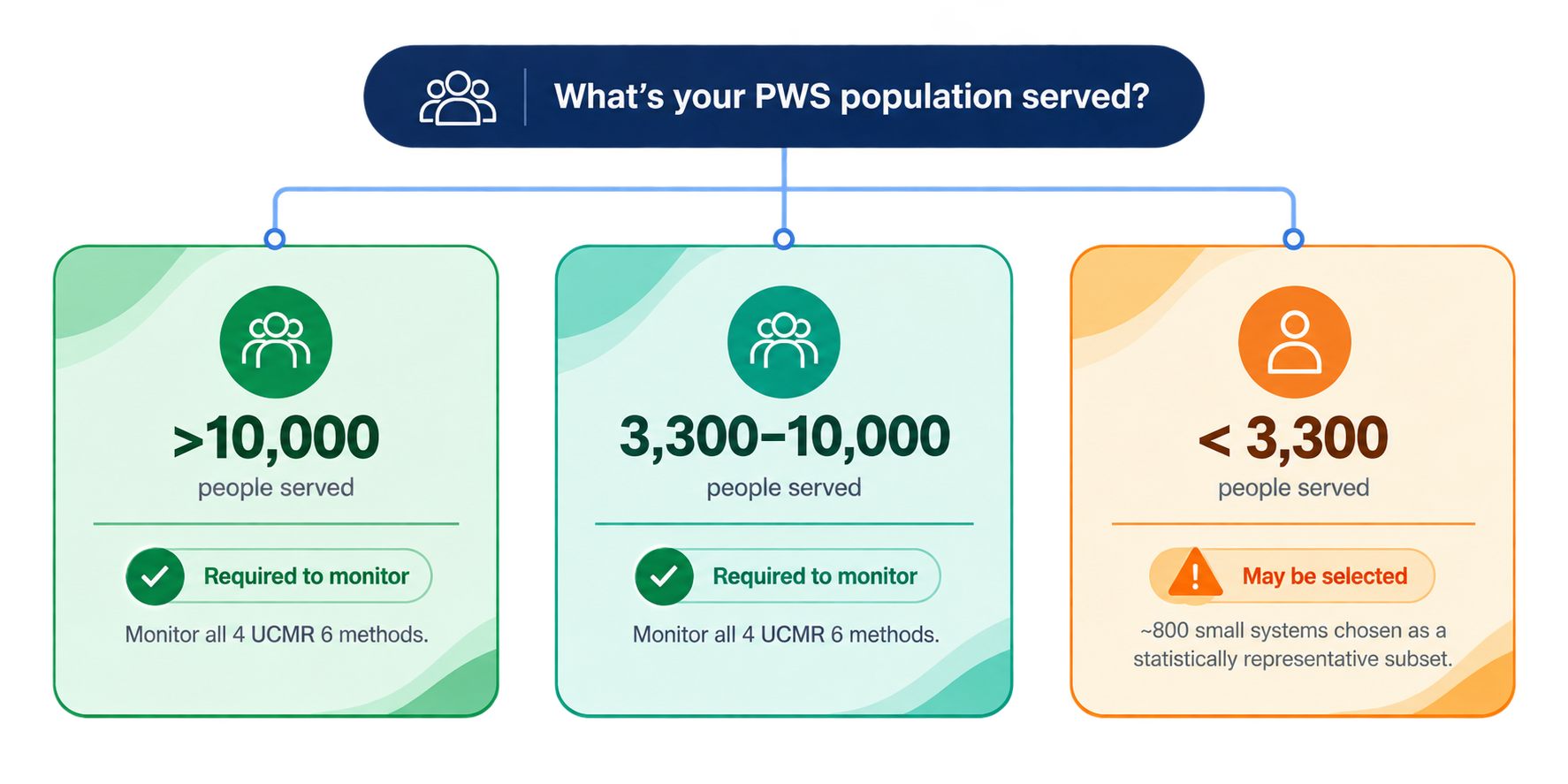
Am I required to monitor?
EPA Methods & Contaminants
EPA’s proposed UCMR 6 includes 30 contaminants across four analytical methods, each with specific sample preparation and instrumentation requirements. Explore the methods, contaminants, and key laboratory considerations to help your laboratory prepare for UCMR 6 monitoring.
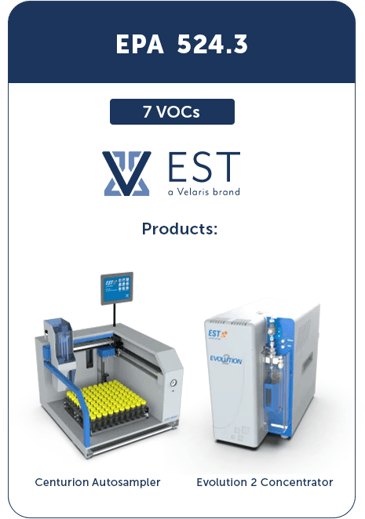
EPA METHOD 524.3
7 - Analytes
Volatile Organic Compounds (VOCs)
- 1,1,2,2-Tetrachloroethane
- 1,1,1,2-Tetrachloroethane
- 1,2,3-Trichloropropane (1,2,3-TCP)
- 1,2,4-Trimethylbenzene
- Hexachlorobutadiene
- Naphthalene
- Total 1,3-dichloropropene (cis- & trans-)
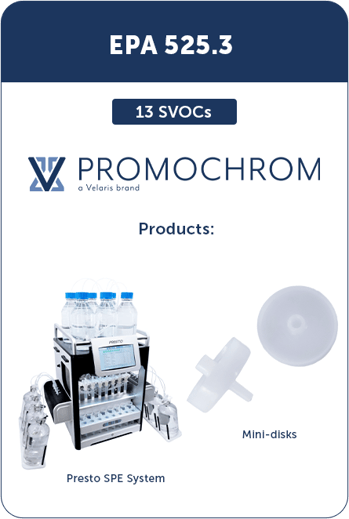
EPA METHOD 525.3
13 - Analytes
Semivolatile Organic Compounds (SVOCs)
- 2,4-Dinitrotoluene
- 2,6-Dinitrotoluene
- Anthracene
- Chlorothalonil
- Dichlorvos (DDVP)
- Fluorene
- Isophorone
- Metribuzin
- N,N-diethyl-m- toluamide (DEET)
- Phorate
- Pyrene
- Tetrachlorvinphos (Stirofos)
- Trifluralin
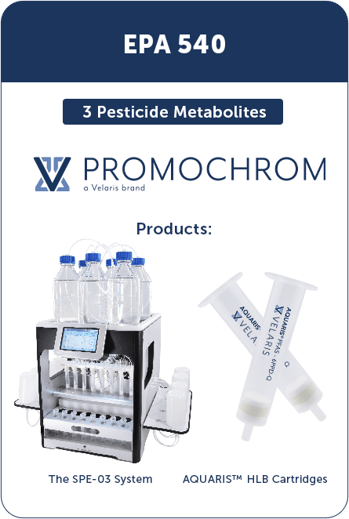
EPA METHOD 540
3 - Analytes
Pesticide Metabolites Breakdown
- Chlorpyrifos oxon
- Phorate sulfone
- Phorate sulfoxide
EPA METHOD 563
7 - Analytes
Ultrashort Organofluorine Compounds
- Bistriflimide (TFSI)
- Perfluoro-2-methoxyacetic acid (PFMOAA)
- Perfluoroethanesulfonic acid (PFEtS)
- Perfluoropropanesulfonic acid (PFPrS)
- Perfluoropropanoic acid (PFPrA)
- Trifluoromethanesulfonic acid (TFMS)
- Trifluoroacetic acid (TFA)

Contaminant group notes
- VOCs (EPA 524.3): solvents and chemical intermediates, including chlorinated compounds and one pesticide.
- SVOCs (EPA 525.3): pesticides, pesticide degradates, PAHs, and nitroaromatics.
- Pesticide metabolites (EPA 540): breakdown products of widely used organophosphate pesticides.
- Ultrashort PFAS (EPA 563): next-generation PFAS not captured by UCMR 5's methods (EPA 533/537.1) — too small and mobile for those sorbents to retain.
One partner. Four methods.

Four methods. Multiple contaminants. One partner for automated solutions.
Velaris brings together PromoChrom and EST Analytical to provide automated solutions across all four UCMR 6 analytical methods currently available. Our solutions help laboratories build efficient, reliable workflows while reducing the complexity of sourcing and supporting equipment from multiple vendors.
And our support goes beyond the instruments. Regional technical teams and dedicated resources provide application expertise and ongoing technical support to help your lab prepare for and implement UCMR 6 workflows.

Application Notes
Explore application notes demonstrating how PromoChrom and EST Analytical solutions can support automated workflows for UCMR 6-related methods. Get practical insights into sample preparation, method performance, and workflow considerations to help your laboratory prepare for UCMR 6.
EPA Method 524.3 | Available
-
How to Shorten Cycle Times for USEPA Method 524.3 Using the Evolution 2 Purge and Trap Concentrator
-
The Effects of Purge Flow on USEPA Method 524.3 Compounds
- A USEPA Method 524.3 Purge Volume Comparison Using the Evolution 2 Purge and Trap Concentrator
-
Purge Flow Effects on USEPA Method 524.3 Compounds
EPA Method 525.3 | Available
- An Efficient Approach to Extract over 100 Semi-Volatile Organic Compounds using SPE Mini-disks with Automated SPE Systems
EPA Method 540 | Release est. Nov 2026
EPA Method 563 | Coming soon
Complete the Form to Read More of Our Application Notes
Frequently Asked Questions
Have Question? We are here to help!
What is UCMR 6?
UCMR 6 is EPA's proposed Sixth Unregulated Contaminant Monitoring Rule under the Safe Drinking Water Act. It requires public water systems to monitor for contaminants that aren't yet regulated, so EPA can decide what to regulate next.
Which water systems have to participate?
All public water systems serving more than 10,000 people are required to monitor, along with systems serving 3,300–10,000 people. Roughly 800 smaller systems (under 3,300 people) are selected as a statistically representative subset.
When is the deadline for laboratories to apply for UCMR 6 approval?
According to the U.S. EPA, laboratories participating in the UCMR 6 Laboratory Approval Program must register and complete the required application materials by August 1, 2027.
When does monitoring start?
As proposed, the monitoring window runs from January 2028 through December 2030.
How is UCMR 6's PFAS testing different from UCMR 5's?
UCMR 5 used EPA Methods 533 and 537.1 to test 29 legacy PFAS. UCMR 6 adds EPA Method 563, a newly developed method targeting 7 ultrashort-chain PFAS and related fluorinated compounds too small and mobile for the older methods' sorbents to retain.
What equipment will my lab need?
It depends which methods your lab runs. See sections above for the full method-to-product mapping, or talk to our team for a workflow assessment specific to your lab.
Where can I get help preparing?
Reach out to our team directly — we're happy to walk through what UCMR 6 means for your specific lab.